
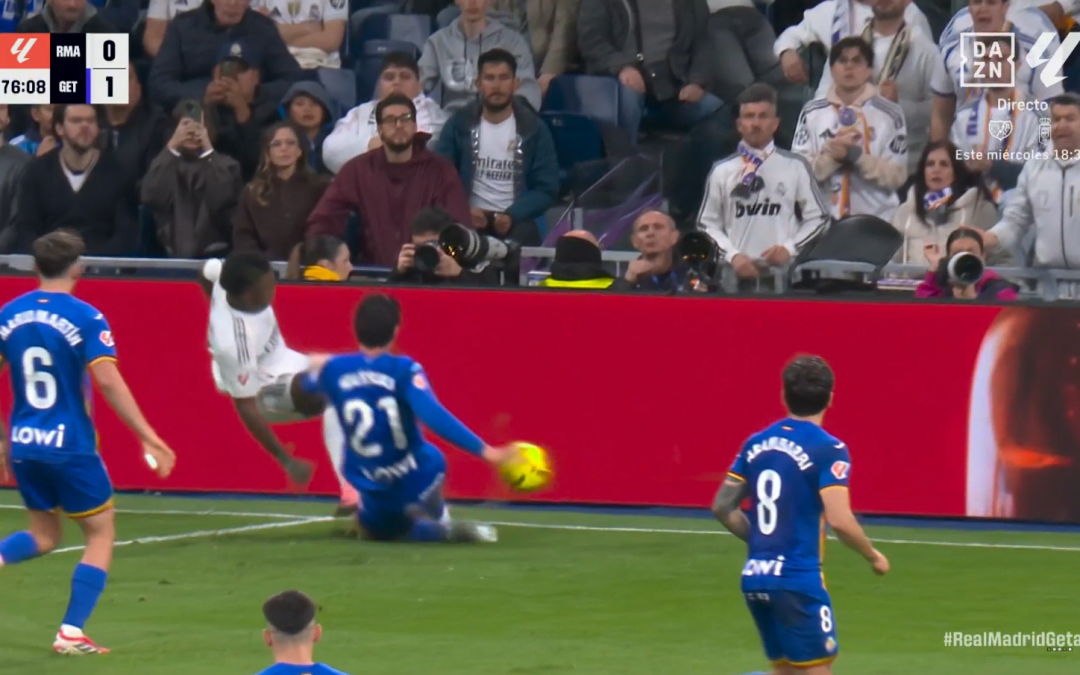
Muñiz Ruiz firmó un arbitraje catastrófico en el Real Madrid – Getafe con Pizarro Gómez, en el VAR, cometiendo el error más grave de la temporada.
El Real Madrid – Getafe dejó seis acciones polémicas de gran calibre y un arbitraje de Alejandro Muñiz Ruiz que puede calificarse sin rodeos como catastrófico. La actuación estuvo al borde del suspenso más severo y solo dos decisiones correctas en acciones muy concretas evitaron una nota todavía más baja. De hecho, el balance global apenas alcanza el 2,0, y pudo ser incluso inferior.
Agresión gravísima de Rudiger a Diego Rico
La primera acción marca el tono del encuentro: la agresión de Antonio Rüdiger a Diego Rico. Con el jugador del Getafe en el suelo, Rüdiger impacta con la rodilla de forma claramente voluntaria. No es un gesto natural, no es una caída fortuita, no es una acción disputando el balón. Es una agresión sin excusa, con el jugador del Real Madrid pendiente únicamente de su rival, sin mirar el balón en ningún momento. Eso le termina por delatar claramente. En directo puede entenderse que el árbitro no la perciba por la velocidad de la jugada, pero que el VAR, con repeticiones y distintos ángulos, no intervenga resulta incomprensible. Es, probablemente, la roja más clara de la temporada y una de las más evidentes de los últimos años. La no intervención desde el VAR agrava todavía más el error.
🖥️💥 El VAR pasó por completo de una clara agresión de Rüdiger a Rico.
👉🏻 El alemán, que solo fija la mirada en su rival, le da un rodillazo de forma intencionada en el rostro.
❌ 𝗥𝗢𝗝𝗔 𝗗𝗜𝗥𝗘𝗖𝗧𝗔 𝗖𝗟𝗔𝗥𝗔.
▪️ Incomprensible la pasividad de Pizarro Gómez desde el VAR. pic.twitter.com/4Io4PL5nk2
— Archivo VAR (@ArchivoVAR) March 2, 2026
¿Hay penalti de Romero sobre Gonzalo?
La segunda acción polémica se produce en el área del Getafe. Gonzalo controla dentro del área y se dispone a rematar cuando Romero llega y despeja el balón medio segundo antes del impacto. El delantero termina golpeando la plancha del defensor. Aquí la clave está en el orden de la acción: el defensor toca balón primero. Por tanto, no es penalti. Si Gonzalo hubiera rematado antes y luego se produjera el planchazo sin balón de por medio, estaríamos ante una infracción clara. Pero no es el caso. Decisión correcta.
⁉️💥 ¿Es penalti la acción entre Zaid Romero y Gonzalo?
✅ 𝗡𝗢.
👉🏻 El central del Getafe se anticipa, despeja el balón y, tras ello, se produce el contacto entre él y Gonzalo.
▪️ De haber llegado antes el delantero al balón, la acción sí sería punible. pic.twitter.com/xvn6wXHNb6
— Archivo VAR (@ArchivoVAR) March 2, 2026
¿Es punible la mano de Juan Iglesias?
También estuvo acertado Muñiz Ruiz en la posible mano de Juan Iglesias. El balón rebota en su tacón y posteriormente impacta en una mano abierta, sí, pero en movimiento hacia el punto de apoyo al lanzarse al suelo. Según la normativa actual, esa mano no es punible. Son las dos acciones que sostienen mínimamente su actuación.
⁉️💥 ¿Es penalti la acción entre Zaid Romero y Gonzalo?
✅ 𝗡𝗢.
👉🏻 El central del Getafe se anticipa, despeja el balón y, tras ello, se produce el contacto entre él y Gonzalo.
▪️ De haber llegado antes el delantero al balón, la acción sí sería punible. pic.twitter.com/xvn6wXHNb6
— Archivo VAR (@ArchivoVAR) March 2, 2026
La jugada que fue el principio de su final
A partir de ahí, el partido se le escapa. La amarilla a Aurélien Tchouaméni es el ejemplo más claro. La jugada nace de un empujón intenso de Mario Martín sobre Carrera. El balón continúa, hay disputa y Tchouaméni pisa levemente de forma lateral el pie del rival tras tocar balón. No es una acción violenta ni temeraria. No es ni siquiera falta clara. Sin embargo, Muñiz Ruiz decide amonestar al francés ignorando la infracción previa. Esa decisión desquicia el encuentro.
La expulsión de Mastantuono con roja directa
La crispación acumulada desemboca en la expulsión de Mastantuono por roja directa tras dirigirse al árbitro con un “esto es una puta vergüenza”. El reglamento protege al árbitro ante insultos, pero es evidente que el contexto influye. Un partido mal gestionado, con permisividad excesiva a los contactos del Getafe en la segunda parte, terminó explotando. Pese a ello, la expresión de argentino es una roja directa clara y así fue mostrada por el colegiado gallego.
La expulsión de Liso con doble amarilla
La sexta acción polémica llega ya en el descuento con la expulsión de Liso por desplazar el balón teniendo amarilla. Correcta aplicación disciplinaria, aunque se produce en el minuto 97, dentro del tiempo añadido. Y precisamente el añadido fue otro punto discutible. Solo cinco minutos en un segundo tiempo con dos revisiones de VAR, interrupciones prolongadas y tensión constante resulta corto. No es un error flagrante, pero sí una gestión poco coherente con el desarrollo real del partido.
Balance total de Muñiz Ruiz
El resumen es claro: Muñiz Ruiz vuelve a demostrar que los partidos de alta intensidad le superan. No es un caso aislado ni puntual. Ha ocurrido en varias ocasiones en encuentros de gran escaparate. Sin embargo, el CTA continúa designándole para choques de máxima exigencia. Lo mismo sucede con otros colegiados que, independientemente del rendimiento, siguen recibiendo partidos de gran exposición.
El problema no es un error concreto. El problema es la repetición del patrón. Y en el Real Madrid – Getafe, el arbitraje volvió a quedar muy por debajo del nivel que exige un partido de Primera División.
🇬🇧 Read full English version
Muñiz Ruiz delivered a catastrophic performance in Real Madrid – Getafe, with Pizarro Gómez in the VAR room committing the most serious error of the season
The Real Madrid – Getafe match left six major controversial incidents and a refereeing display from Alejandro Muñiz Ruiz that can be described, without exaggeration, as catastrophic. His performance bordered on a severe failure, and only two correct decisions in very specific situations prevented an even lower rating. In fact, the overall assessment barely reaches 2.0, and it could easily have been worse.
Rüdiger’s extremely serious aggression against Diego Rico
The first incident sets the tone of the match: Antonio Rüdiger’s aggression against Diego Rico. With the Getafe player on the ground, Rüdiger deliberately strikes him with his knee. It is not a natural gesture, not an accidental fall, not a challenge for the ball. It is an unjustifiable act of aggression, with the Real Madrid player focused solely on his opponent, never looking at the ball at any moment — something that clearly exposes his intent.
It is understandable that the referee might miss it in real time due to the speed of the action. However, the fact that VAR, with access to replays and multiple angles, did not intervene is incomprehensible. It is probably the clearest red card of the season and one of the most obvious in recent years. The lack of VAR intervention makes the mistake even more serious.
Was there a penalty by Romero on Gonzalo?
The second controversial moment occurred inside the Getafe penalty area. Gonzalo controls the ball and prepares to shoot when Romero arrives and clears the ball half a second before contact. The forward then ends up striking the defender’s boot.
The key here is the sequence of events: the defender plays the ball first. Therefore, it is not a penalty. If Gonzalo had managed to shoot first and the defender’s studs had then caught him without touching the ball, it would clearly be a foul. But that is not the case. Correct decision.
Is Juan Iglesias’ handball punishable?
Muñiz Ruiz was also correct in the possible handball by Juan Iglesias. The ball rebounds off his heel and then strikes an open arm, yes — but the arm is moving toward the supporting position as he throws himself to the ground.
According to current handball guidelines, that action is not punishable. These two situations are the only ones that minimally sustain his overall performance.
The decision that marked the beginning of the end
From that point on, the match slipped out of his control. The yellow card shown to Aurélien Tchouaméni is the clearest example. The play originates from a strong push by Mario Martín on Carrera. The ball continues, there is a duel, and Tchouaméni lightly steps laterally on his opponent’s foot after having touched the ball first.
It is neither a violent nor reckless action. It is not even a clear foul. However, Muñiz Ruiz decides to caution the French midfielder, ignoring the previous infringement. That decision unsettled the match entirely.
Mastantuono’s straight red card
The accumulated tension ultimately led to Mastantuono’s dismissal with a straight red card after addressing the referee with the words “this is a fucking disgrace.” The Laws of the Game protect referees against insults, but context clearly plays a role.
A poorly managed match, with excessive leniency toward Getafe’s physical challenges in the second half, eventually exploded. Nevertheless, the expression used by the Argentine player warrants a direct red card, and that was correctly shown by the Galician referee.
Liso’s second yellow card
The sixth controversial incident came in stoppage time, with Liso being sent off for kicking the ball away while already on a yellow card. It was a correct disciplinary decision, although it occurred in the 97th minute, deep into added time.
And added time itself was another debatable point. Only five minutes were indicated in a second half that included two VAR reviews, prolonged interruptions, and constant tension. It is not a blatant error, but it does reflect management that was inconsistent with the actual flow of the match.
Overall assessment of Muñiz Ruiz
The conclusion is clear: Muñiz Ruiz once again demonstrates that high-intensity matches overwhelm him. This is not an isolated case. It has happened on several occasions in high-profile fixtures. Yet the Technical Committee of Referees continues to appoint him for matches of maximum demand.
The same applies to other officials who, regardless of performance levels, continue to receive high-exposure appointments.
The problem is not a single mistake. The problem is the repeated pattern. And in Real Madrid – Getafe, the refereeing once again fell well below the standard required for a Primera División match.