
Un Celta de Vigo – Real Madrid con cinco acciones polémicas y un arbitraje muy pobre de Díaz de Mera Escuderos.
El partido entre Celta de Vigo y Real Madrid dejó una importante dosis de polémica arbitral con hasta cinco acciones discutidas a lo largo del encuentro. El colegiado Díaz de Mera Escuderos firmó una actuación bastante deficiente, acumulando errores de apreciación, decisiones disciplinarias cuestionables y varios momentos en los que perdió el control del criterio del partido. Aun así, dentro de un arbitraje claramente negativo, también tuvo dos decisiones correctas que evitaron que su valoración final fuese todavía peor.
El Celta de Vigo debió jugar con diez desde el segundo 37
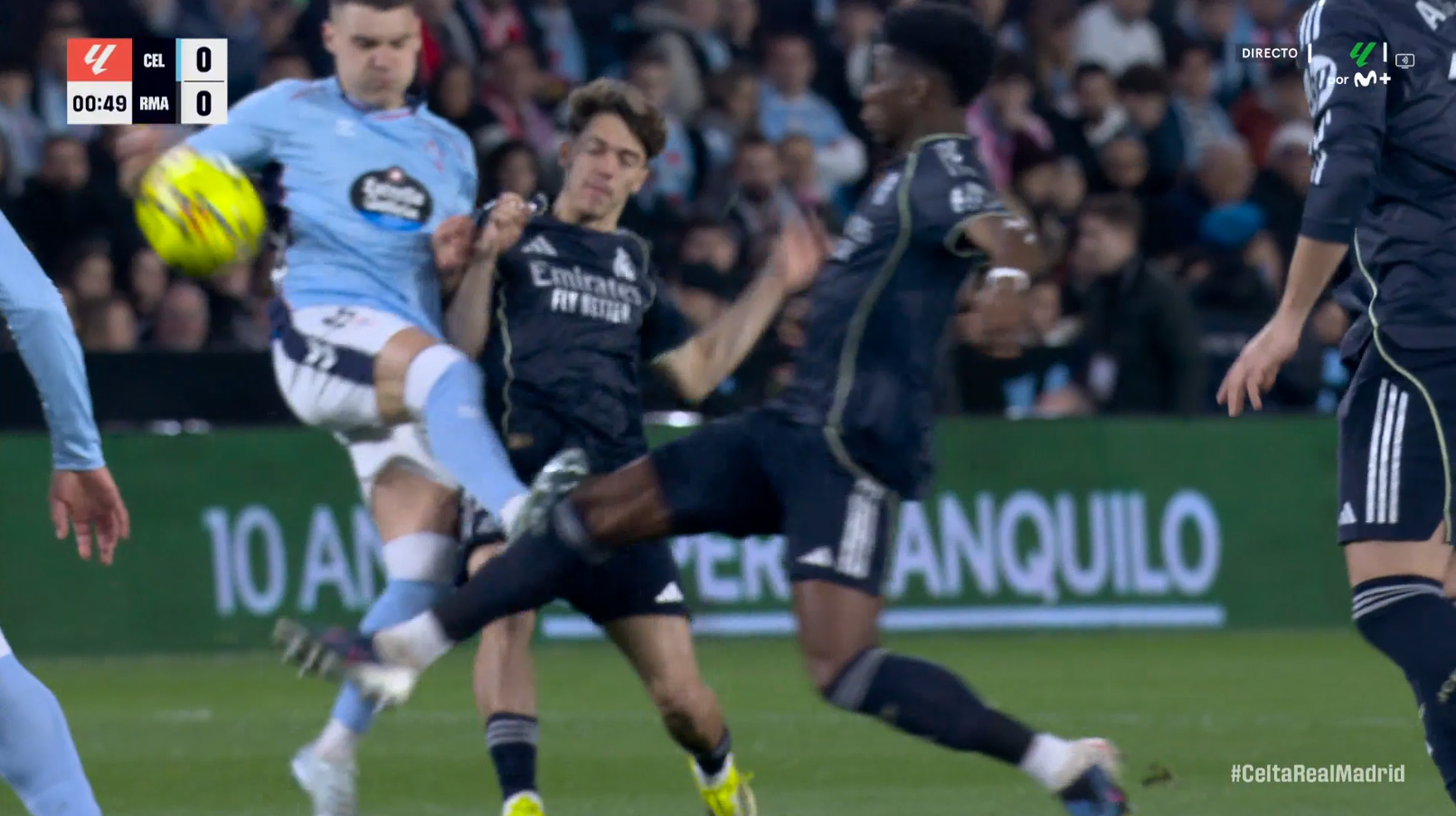
La primera gran polémica llegó prácticamente con el pitido inicial. En el segundo 37 de partido se produjo un balón dividido al que acudieron Tchouaméni, Thiago y Ferran Jutglà. El jugador del Real Madrid consiguió puntear primero el balón hacia arriba y, en ese momento, Jutglà llegó con la plancha intentando disputar la jugada. El resultado fue un impacto muy feo de los tacos del jugador del Celta directamente contra la rodilla de Tchouaméni. La acción es muy clara: una entrada con plancha, tacos y rodilla que, como mínimo, debió ser sancionada con falta y tarjeta amarilla, y que incluso admite perfectamente la tarjeta roja directa por juego peligroso.
Sin embargo, Díaz de Mera no señaló absolutamente nada. Puede entenderse que no viera bien la acción al producirse un choque entre varios jugadores, pero el asistente sí estaba en buena posición para detectarla. Que ni siquiera se señalara falta convierte la jugada en uno de los errores más graves del partido. De haberse sancionado correctamente, el Celta habría jugado prácticamente todo el encuentro con diez jugadores.
¿El saque de esquina previo al gol de Tchouameni es correcto?
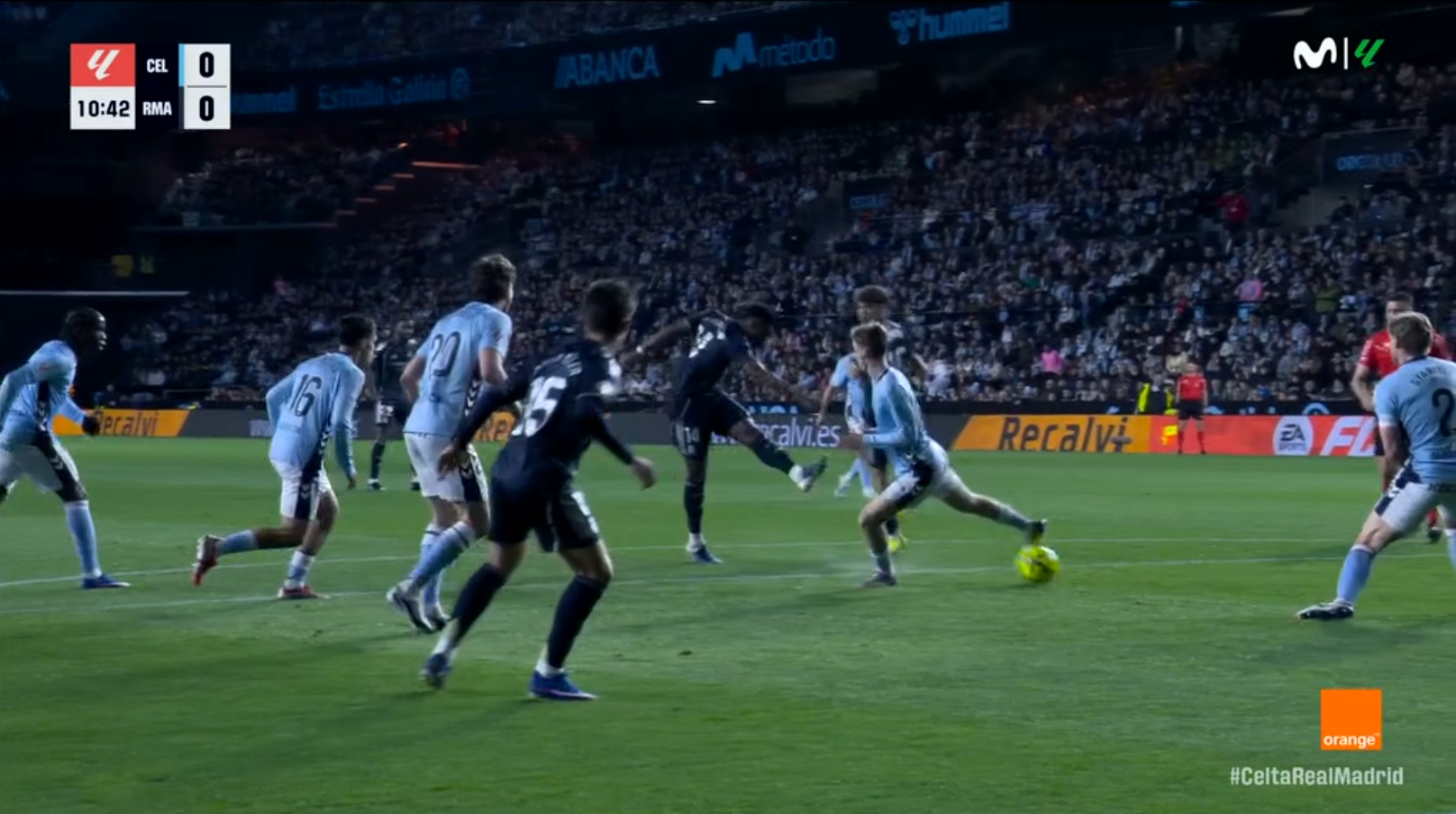
La segunda acción polémica llegó en el córner que dio origen al primer gol del Real Madrid. Algunos aficionados y analistas sostuvieron que ese saque de esquina no debía haberse señalado, ya que aparentemente el balón no lo tocaba ningún jugador del Celta antes de salir por línea de fondo. Sin embargo, el análisis de la jugada muestra que Swedberg llega a rozar levemente el balón con la puntera antes. El contacto es mínimo y casi imperceptible a simple vista, pero existe. Díaz de Mera estaba muy cerca de la acción y acertó al señalar córner, una de las pocas decisiones correctas del colegiado durante el encuentro.
Acción al límite entre Arda Güler y Mingueza
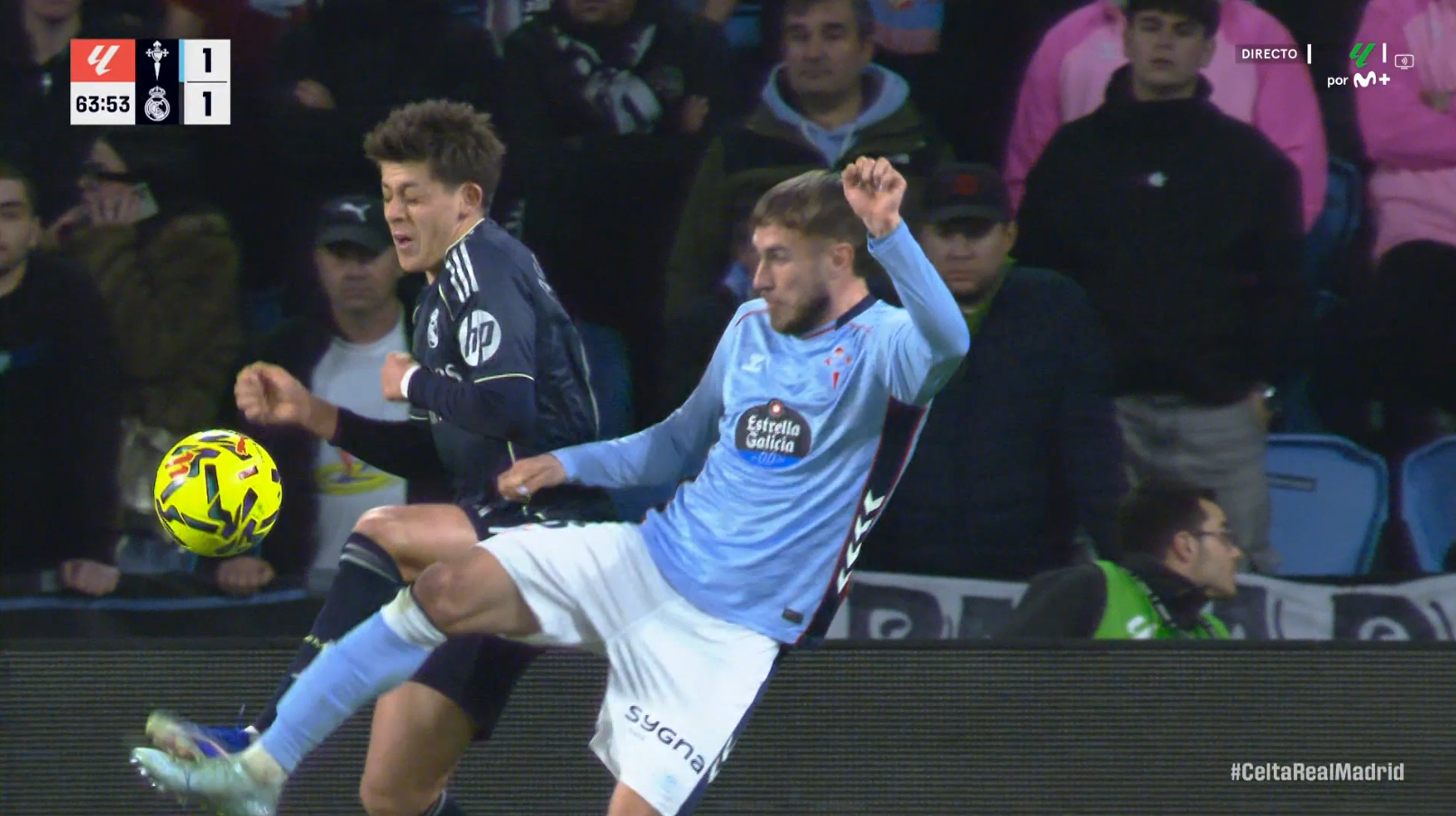
Ya en la segunda parte llegó otra jugada que generó debate: una posible caída de Arda Güler dentro del área. En la acción, Mingueza intenta despejar un balón y termina contactando lateralmente con el pie del jugador del Real Madrid. El contacto existe, aunque no es especialmente intenso. Lo llamativo de la jugada es que Güler intenta continuar la jugada y solo se deja caer unos segundos después, cuando el balón ya se le ha escapado. Ese pequeño “delay” en la caída probablemente influyó en que Díaz de Mera no señalara penalti.
En este caso la decisión de no pitar penalti es defendible, sobre todo porque el contacto no tiene una intensidad clara como para que el VAR pueda intervenir al no tratarse de un error obvio y manifiesto. Eso sí, Mingueza se la juega: si el penalti se hubiera señalado en directo, probablemente el VAR lo habría validado.
Dos errores en una misma acción
La cuarta jugada polémica fue una de las más llamativas del partido. En un córner, Ferran Jutglà golpeó claramente el balón con la mano dentro del área en lo que puede considerarse una de las manos más evidentes de la temporada. El balón se dirigía hacia su zona y el jugador del Celta lo desvía directamente con el brazo. Sorprendentemente, Díaz de Mera no vio la acción en directo pese a estar perfectamente situado para ello. El VAR le llamó al monitor, pero la revisión terminó detectando una infracción previa en el propio saque de esquina. En la jugada, Palacios empuja con ambos brazos a Ilaix Moriba para apartarlo de la zona de influencia del balón. Aunque Moriba exagera la caída, el empujón existe y es anterior a la mano, por lo que el árbitro sancionó correctamente falta en ataque antes de la infracción posterior.
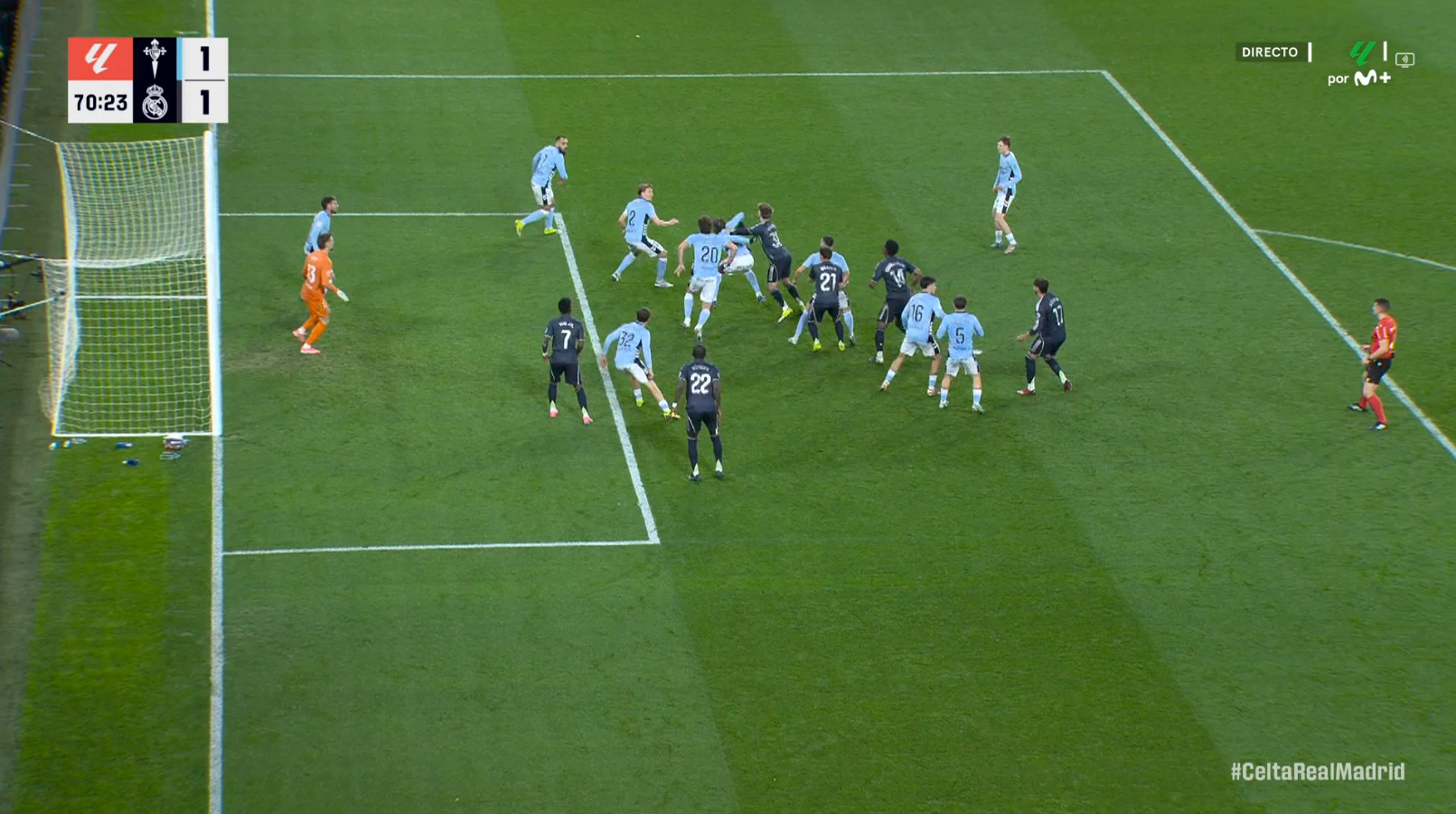
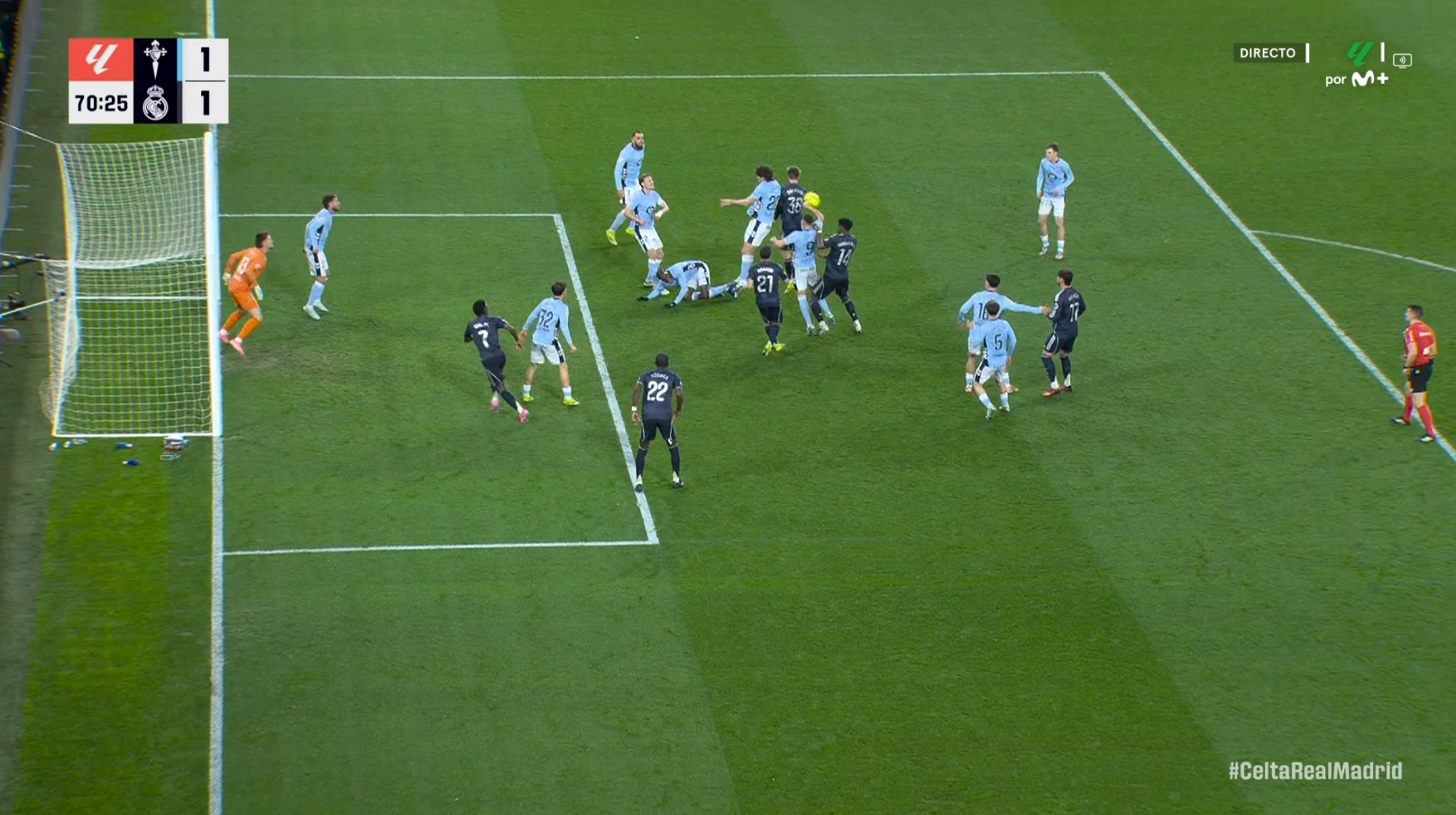
La acción más polémica del partido
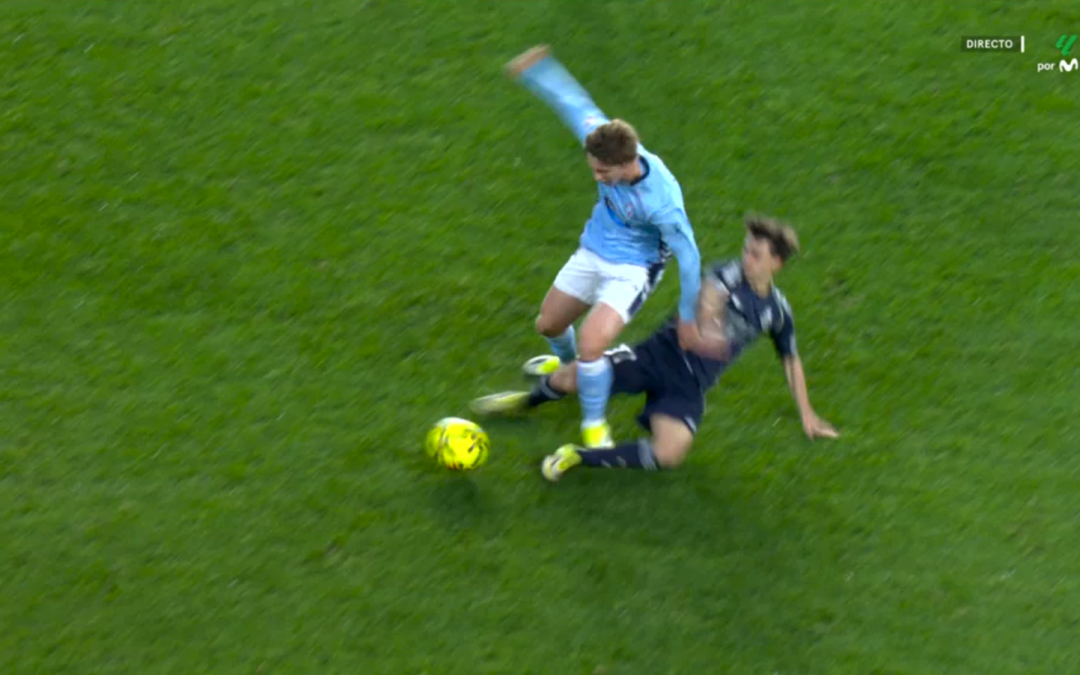
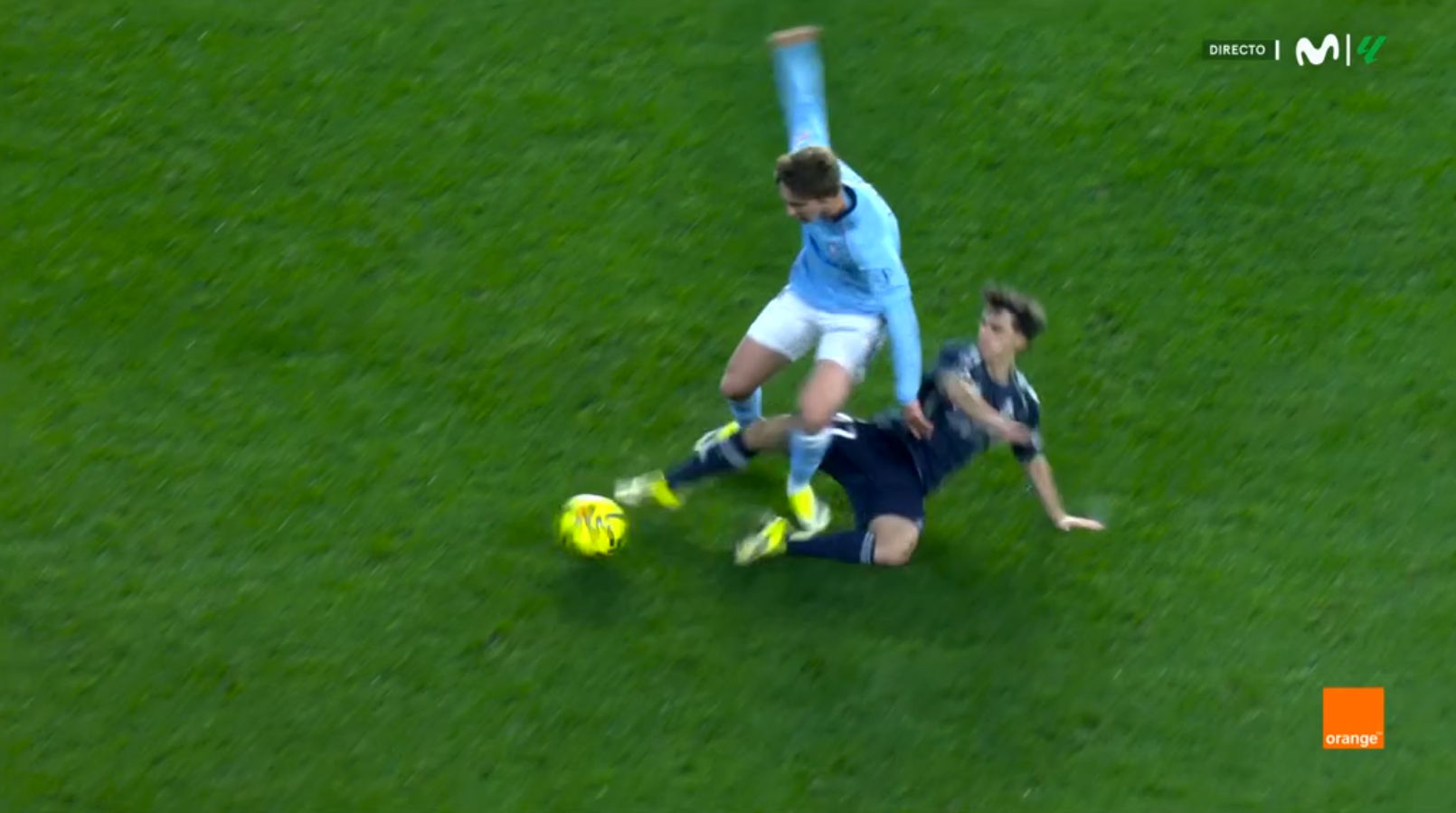
La quinta y última acción es la que más debate ha generado, ya que de ella nace la recuperación que termina dando lugar al gol de la victoria del Real Madrid. En la jugada, Fer López controla inicialmente el balón, pero se le queda ligeramente largo. Manuel Ángel llega desde un lateral y consigue puntear el balón antes que el jugador del Celta. En el movimiento posterior, y fruto del arrastre de la jugada, la pierna derecha del jugador madridista impacta con la pierna de Fer López. Es importante entender bien la mecánica de la acción: Fer López estira la pierna intentando evitar que Manuel Ángel llegue al balón colocando su pierna entre el balón y la pierna de su rival, pero no lo consigue.
Aquí está la clave de toda la acción. Fer López no decide ir directamente a jugar el balón. De hecho, por proximidad podría haber intentado puntearlo o llevárselo. Sin embargo, en lugar de atacar el balón, lo que hace es intentar protegerlo colocando su pierna entre el balón y la llegada del jugador del Real Madrid. Es decir, trata de interponer su cuerpo para impedir que Manuel Ángel pueda llegar antes. El problema es que esa maniobra no le sale. Manuel Ángel se anticipa al movimiento y consigue puntear el balón primero. En ese momento la posesión cambia completamente.
— ELYMANE RM (@ElimaneRM) March 6, 2026
A partir de ahí se produce el contacto que ha generado la polémica. Tras puntear el balón, Manuel Ángel continúa su movimiento natural y en el arrastre de la jugada su pierna impacta con la de Fer López, que previamente había estirado la pierna intentando cerrar el espacio. El contacto existe, pero llega después de que el jugador del Real Madrid haya ganado claramente la disputa por el balón.
¿Podría ser una acción temeraria?
Además, tampoco se trata de una acción temeraria. No hay tijera pese a lo que puede parecer por perspectiva en algunas tomas, ya que la pierna izquierda queda fuera de la acción una vez se produce el punteo de balón. De hecho, el contacto principal se produce con el muslo y no con el pie o los tacos, lo que reduce todavía más el riesgo de temeridad. Es una imagen que en algunas repeticiones puede parecer más aparatosa de lo que realmente es, pero el análisis de la jugada muestra que se trata de un choque derivado de la anticipación previa.
También es importante diferenciar este tipo de situaciones de otras que sí se sancionan como falta. Por ejemplo, cuando un jugador centra el balón y después recibe un impacto claro en la pierna de apoyo. En ese caso, aunque el balón ya haya salido de su pie, el contacto puede ser punible porque la acción del jugador todavía forma parte de la jugada ofensiva si existe temeridad. Aquí ocurre lo contrario: Fer López pierde la posesión al intentar proteger el balón y fallar en ese intento, y el contacto posterior llega cuando la jugada ya ha cambiado de dueño.
Además, Fer López se levanta al instante del césped y acude a defender la acción de ataque del Real Madrid, evidenciando que la acción de Manuel Ángel no supuso un daño claro en el jugador del Celta de Vigo, algo que suele dar pistas al VAR a la hora de valorar la revisión de una acción. Tras el gol de Valverde, tampoco protesta al colegiado la acción, lamentándose por la pérdida de balón.
Balance final
En definitiva, el arbitraje de Díaz de Mera Escuderos dejó más sombras que luces. Cometió errores importantes, regaló algunas tarjetas y tuvo dificultades para mantener un criterio claro durante el encuentro. Aun así, en las acciones decisivas el VAR evitó que los errores se multiplicaran, dejando un balance arbitral irregular en un partido que terminó marcado por la polémica.
🇬🇧 Read full English version
Celta de Vigo – Real Madrid: five controversial incidents and a very poor refereeing performance by Díaz de Mera Escuderos
The match between Celta de Vigo and Real Madrid produced a significant amount of refereeing controversy, with up to five debatable incidents throughout the game. Referee Díaz de Mera Escuderos delivered a clearly disappointing performance, accumulating several judgment errors, questionable disciplinary decisions and multiple moments in which he appeared to lose control of the game’s overall criteria. Even so, despite an overall negative display, he did make two correct calls that prevented the final evaluation of his performance from being even worse.
Celta should have been reduced to ten players after 37 seconds
The first major controversy arrived almost immediately after kick-off. In the 37th second of the match, a loose ball was contested by Tchouaméni, Thiago and Ferran Jutglà. The Real Madrid player managed to poke the ball upward first and, at that moment, Jutglà arrived with his studs raised while trying to challenge for it. The result was a very dangerous impact, with the studs of the Celta player hitting Tchouaméni directly on the knee.
A challenge with the studs exposed that should at the very least have resulted in a foul and a yellow card, and which could perfectly justify a straight red card for dangerous play.
However, Díaz de Mera did not signal anything at all. It can be understood that he may not have seen the incident clearly due to the number of players involved, but the assistant referee was in a good position to detect it. The fact that not even a foul was awarded turns this moment into one of the most serious mistakes of the match. Had it been punished correctly, Celta would have played almost the entire game with ten men.
Was the corner before Tchouaméni’s goal correct?
The second controversial moment came from the corner kick that led to Real Madrid’s opening goal. Some fans and analysts argued that the corner should not have been awarded, claiming that the ball had not been touched by any Celta player before crossing the goal line.
However, a closer look at the footage shows that Swedberg slightly touches the ball with the tip of his boot before it goes out. The contact is minimal and almost impossible to detect with the naked eye, but it does exist. Díaz de Mera was very close to the play and made the correct decision by awarding the corner, one of the few accurate calls from the referee during the match.
A borderline incident between Arda Güler and Mingueza
Another debated moment occurred in the second half involving a potential penalty after Arda Güler went down inside the area. In the play, Mingueza attempted to clear the ball and made lateral contact with the Real Madrid player’s foot. The contact exists but is not particularly intense.
The striking aspect of the play is that Güler initially tried to continue the action and only fell a few seconds later, once the ball had already escaped him. That small delay likely influenced Díaz de Mera’s decision not to award a penalty.
In this case, the decision not to give a penalty is defensible, mainly because the contact does not have enough intensity for the VAR to intervene under the “clear and obvious error” standard. Nevertheless, Mingueza was taking a risk: had the penalty been awarded on the field, the VAR would probably have confirmed it.
Two mistakes in the same action
The fourth controversial moment was one of the most striking incidents of the match. During a corner kick, Ferran Jutglà clearly handled the ball inside the penalty area in what could be considered one of the most obvious handballs of the season. The ball was heading directly toward him and the Celta player deflected it with his arm.
Surprisingly, Díaz de Mera failed to detect the handball despite being well positioned. The VAR called him to review the play, but the check ultimately identified a prior infringement during the corner itself. In the build-up, Palacios pushes Ilaix Moriba with both arms in order to move him away from the ball’s trajectory.
Although Moriba exaggerates the fall, the push does exist and occurs before the handball, meaning the referee correctly awarded an attacking foul before the subsequent infringement.
The most controversial moment of the match
The fifth and final incident is the one that generated the most debate, as it led to the recovery that eventually produced Real Madrid’s winning goal. In the play, Fer López initially controls the ball but lets it run slightly away from him. Manuel Ángel arrives from the side and manages to poke the ball first before the Celta player.
During the follow-through, and as a result of the natural continuation of the play, the Madrid player’s right leg collides with the leg of Fer López. The mechanics of the action are important: Fer López stretches his leg attempting to block Manuel Ángel’s path to the ball, placing it between the ball and his opponent. However, he fails to reach the ball first.
This is the key moment. Instead of directly playing the ball, Fer López attempts to shield it by positioning his leg in front of his opponent. Manuel Ángel anticipates the movement and touches the ball first, which means possession clearly changes at that instant.
The contact that follows occurs only after the Real Madrid player has already won the challenge for the ball. Manuel Ángel continues his natural motion and his leg collides with Fer López, who had extended his leg moments earlier in an attempt to close the space.
Could it be considered reckless?
The action cannot realistically be considered reckless. Despite some camera angles suggesting otherwise, there is no scissor-like movement. The Madrid player’s left leg remains outside the main action after touching the ball. In fact, the primary contact occurs with the thigh rather than the foot or studs, which further reduces any risk of dangerous play.
Some replays may make the incident appear more dramatic than it actually was, but a detailed analysis shows that the collision is simply the natural consequence of Manuel Ángel winning the ball first.
It is also important to distinguish this type of situation from others where a foul is normally awarded, such as when a player delivers a cross and then receives a clear impact on the supporting leg. In those cases the action can still be punishable because the attacking phase continues. Here, however, Fer López loses possession while attempting to shield the ball, and the subsequent contact occurs once the play has already changed hands.
Final assessment
Overall, Díaz de Mera Escuderos’ refereeing performance left more negatives than positives. He made several significant mistakes, issued some questionable cards and struggled to maintain a consistent line throughout the match.
Nevertheless, in the decisive incidents the VAR prevented further errors from escalating, leaving a refereeing display that can best be described as inconsistent in a match ultimately overshadowed by controversy.