
La ida de los octavos de final de la Champions League dejó polémica en prácticamente todos los encuentros.
La ida de los octavos de final de la Champions League dejó una jornada intensa también desde el punto de vista arbitral. De los ocho partidos disputados entre martes y miércoles, seis registraron alguna acción polémica, mientras que solo dos encuentros se desarrollaron sin decisiones discutidas por parte de los colegiados. Algunas de esas jugadas fueron claras y bien resueltas, otras generaron bastante debate y una en particular terminó siendo el error más grave de toda la jornada.
Galatasaray – Liverpool
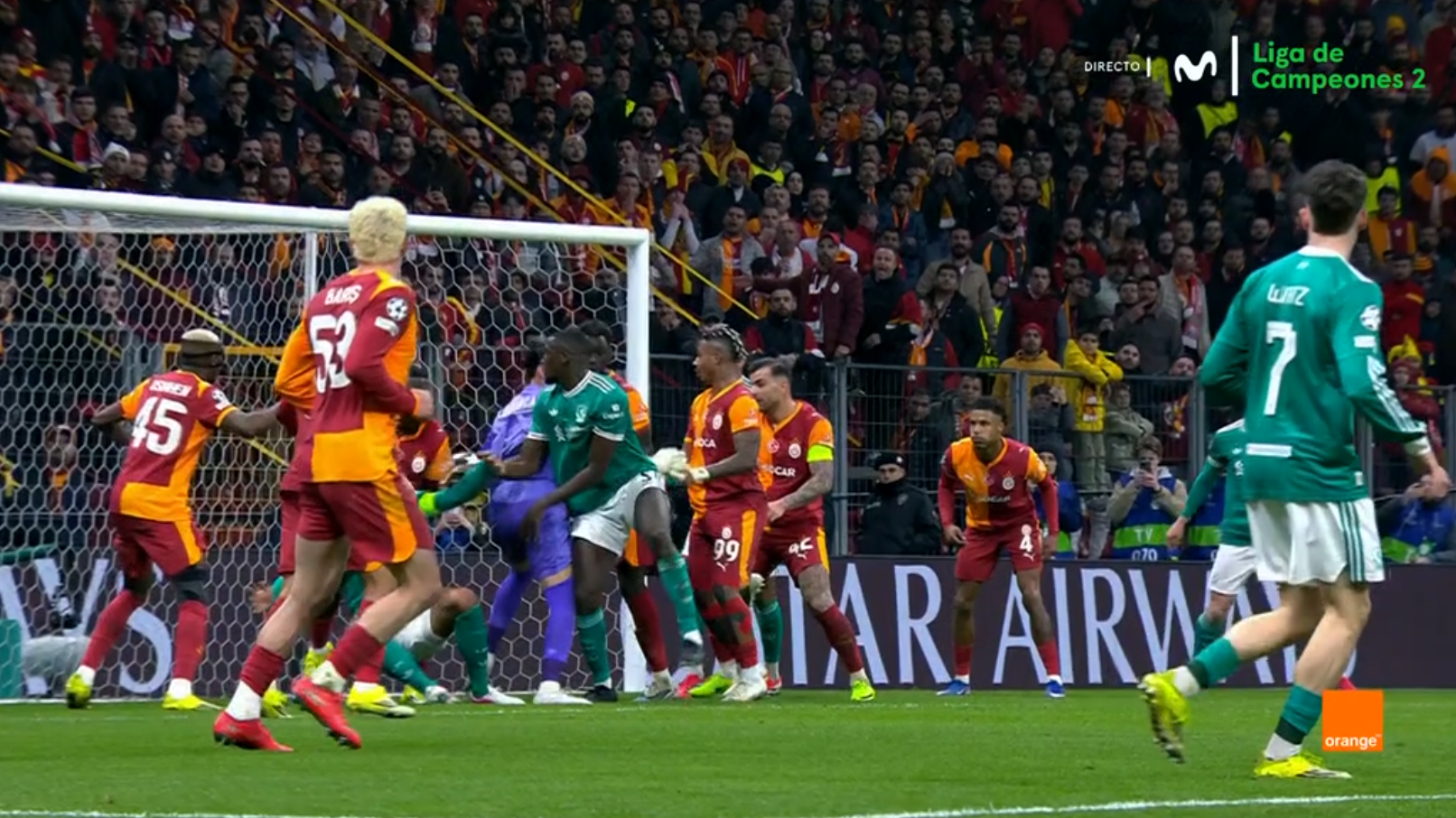
La primera acción polémica se produjo en el Galatasaray – Liverpool. En un córner botado por el conjunto inglés, el central del Liverpool, Konaté, saltó a disputar el balón y terminó golpeándolo con el brazo. Tras ese primer contacto, el balón cayó al suelo, rebotó en un compañero y volvió a impactar en la mano del propio Konaté, aunque en algunas repeticiones también existe la duda de si el segundo toque pertenece a Van Dijk. En cualquier caso, se trataba claramente de un gol con la mano, por lo que la decisión de anularlo fue correcta.
El árbitro del encuentro, Gil Manzano, anuló la acción desde el campo y el VAR confirmó la decisión tras revisar durante unos minutos todas las repeticiones disponibles. En la Champions League, además, no es obligatorio acudir al monitor en este tipo de jugadas si el VAR confirma la decisión de campo, por lo que el procedimiento fue completamente correcto.
Atlético de Madrid – Tottenham
La segunda acción polémica llegó en el Atlético de Madrid – Tottenham, uno de los partidos más calientes de la jornada. En una jugada en la que el Atlético dominaba con claridad el encuentro, el jugador del Tottenham Van de Ven realizó una entrada muy dura sobre Hancko, impactando con la bota a la altura de la tibia. Aunque el jugador toca ligeramente el balón antes del contacto, mantiene la pierna demasiado alta y la acción termina siendo muy peligrosa para el rival.
Se trata de una jugada típica de tarjeta roja directa por juego brusco grave. Sin embargo, el árbitro turco del partido no señaló ni siquiera falta y el VAR tampoco intervino para corregir la acción. Se trata, probablemente, del error arbitral más grave de toda la jornada, aunque por fortuna no tuvo consecuencias importantes en el resultado final del encuentro.
🖥️💥 El VAR perdonó la vida al Tottenham en el Metropolitano.
👉🏻 Van de Ven va con los tacos a una altura muy peligrosa, impactando en la tibia de Hancko.
❌ 𝗘𝗦 𝗥𝗢𝗝𝗔 𝗗𝗜𝗥𝗘𝗖𝗧𝗔.
▪️ Pese a que el holandés toca el balón, realiza una acción de juego brusco grave. pic.twitter.com/GjutNkUKv4
— Archivo VAR (@ArchivoVAR) March 10, 2026
Newcastle – Barcelona
El siguiente partido con polémica fue el Newcastle – Barcelona, un encuentro que ya había generado debate por el penalti señalado en el tiempo añadido sobre Dani Olmo. La acción es bastante sencilla de analizar: el defensor del Newcastle golpea la pierna del jugador azulgrana dentro del área en una jugada que, aunque no es un contacto especialmente fuerte, sí supone una patada clara dentro del área. Es cierto que Dani Olmo exagera la caída, algo habitual en este tipo de jugadas, pero el contacto existe y por tanto el penalti es correcto.
Además, la acción se produce en el minuto 94:23, un momento que algunos criticaron por superar ligeramente los cuatro minutos de descuento señalados inicialmente. Sin embargo, el análisis del tiempo efectivo demuestra que durante el añadido se perdieron prácticamente dos minutos entre una sustitución, una falta ejecutada lentamente y otra jugada con tarjeta amarilla, por lo que el penalti entra perfectamente dentro del tiempo que el árbitro podía añadir.
⁉️💥 ¿Es penalti la acción de Thiaw sobre Dani Olmo?
✅ 𝗦𝗜.
👉🏻 El defensor se come el recorte del jugador español y le lanza una patada en el área.
▪️ Sin ser un contacto muy violento, el movimiento de golpeo le condena. pic.twitter.com/TbGEYCiPYt
— Archivo VAR (@ArchivoVAR) March 10, 2026
Bayer Leverkusen – Arsenal
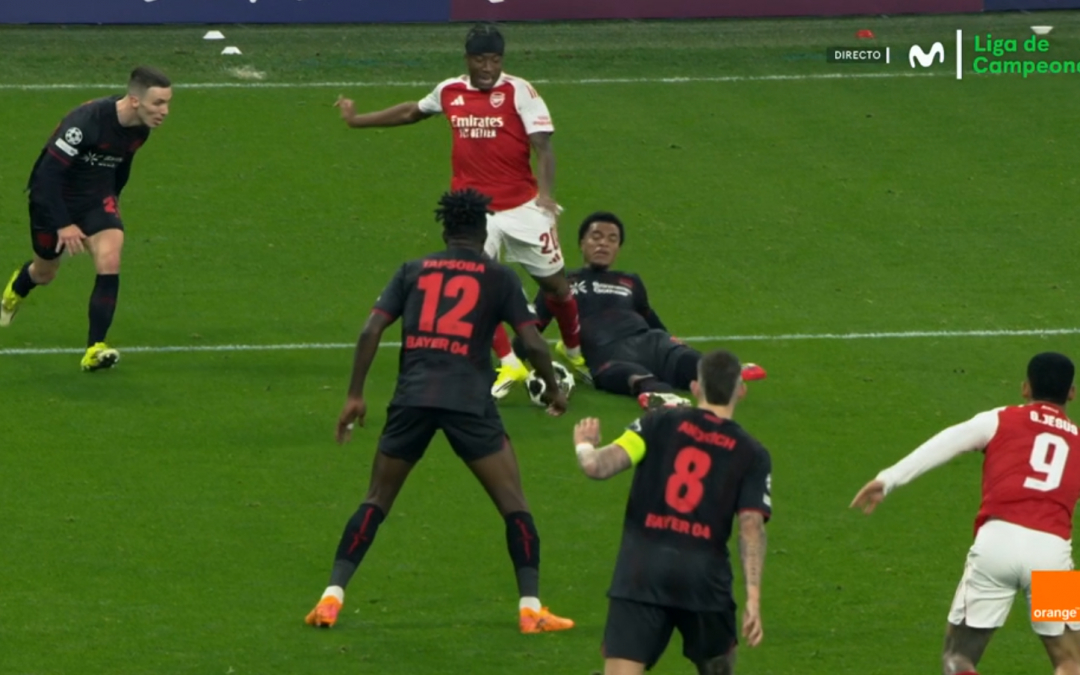
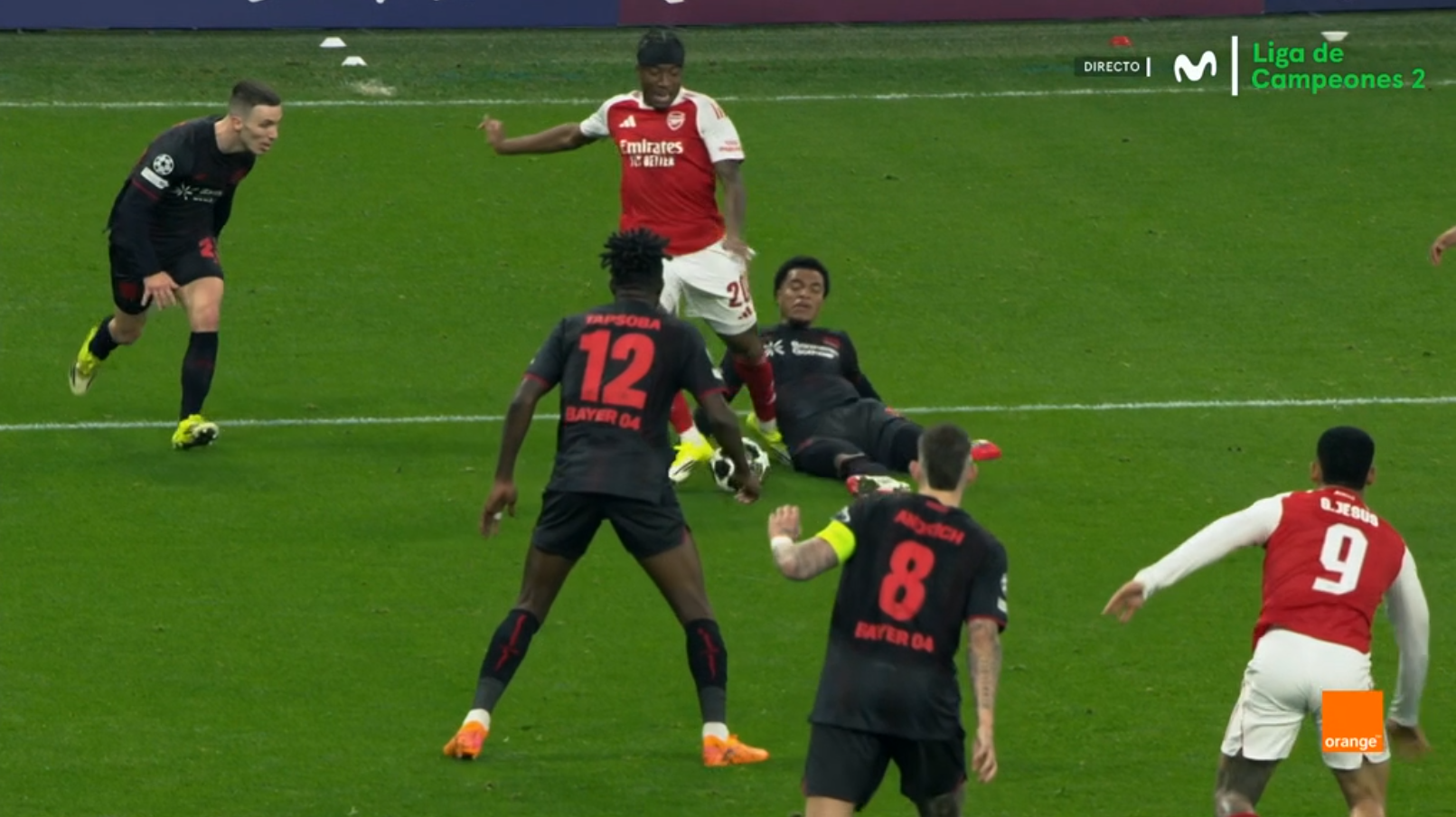
La jugada más debatida de toda la jornada llegó en el Leverkusen – Arsenal. En el minuto 86, con el marcador 1-1, el jugador del Arsenal, Madueke, se internó en el área tras una jugada individual. El defensor del Leverkusen, Tillman, se lanzó al suelo para intentar disputar el balón y terminó cayendo con el cuerpo sobre el pie de apoyo del atacante. El contacto es mínimo y en circunstancias normales no debería considerarse penalti, pero el árbitro del encuentro, Umut Meler, lo señaló en directo.
Ahí entra en juego el protocolo VAR. Al tratarse de un contacto leve pero existente, la jugada pasa a ser interpretativa, lo que significa que el VAR solo puede intervenir si se trata de un error claro y manifiesto. Como el árbitro interpretó que el contacto era suficiente para señalar penalti, el VAR no corrigió la decisión. Es un ejemplo clásico de jugada gris: probablemente no debería haberse pitado, pero una vez señalado desde el campo es muy difícil que el VAR lo anule.
Real Madrid – Manchester City
El quinto episodio polémico llegó en el Real Madrid – Manchester City con un penalti señalado sobre Vinicius tras una acción con Donnarumma. El delantero del Real Madrid recorta al portero italiano dentro del área y en el movimiento se producen dos contactos. Primero, Donnarumma golpea ligeramente el tobillo de apoyo del brasileño con la mano al intentar reaccionar al recorte. Después, cuando Vinicius intenta continuar la carrera, el portero vuelve a tocarle la pierna al recoger el brazo.
Ninguno de los contactos es especialmente fuerte, pero el conjunto de ambos termina generando un trastabilleo claro en el atacante. Son los típicos penaltis que se ven desde hace años cuando un delantero supera al portero dentro del área y el guardameta llega tarde a la acción.
⁉️💥 ¿Hay penalti de Donnarumma sobre Vinicius?
✅ 𝗦𝗜.
👉🏻 El guardameta italiano golpea en el tobillo del brasileño y, tras ello, le contacta por segunda vez en el pie derecho.
▪️ Maurizio Mariani apreció perfectamente la infracción en directo y el VAR la confirmó. pic.twitter.com/8jGpI35RIn
— Archivo VAR (@ArchivoVAR) March 11, 2026
PSG – Chelsea
La última jugada que generó debate se produjo en el Chelsea – PSG, concretamente en el gol del empate del Chelsea cuando el marcador iba 3-2. Joao Pedro empujó el balón a la red tras una jugada ofensiva del conjunto inglés, pero el VAR terminó anulando el tanto por un fuera de juego previo de Enzo Fernández en el inicio de la acción. La repetición muestra con claridad que el centrocampista argentino estaba claramente adelantado, aproximadamente cerca de un metro respecto al último defensor, por lo que la decisión arbitral fue completamente correcta. No se trataba de una jugada milimétrica ni de una situación ajustada que requiriera líneas o tecnología semiautomática para analizarla.

Balance total: Un grave error y una acción muy gris
En resumen, la jornada de ida de los octavos de final de la Champions dejó un balance arbitral relativamente claro. Hubo un error grave, el de la entrada de Van de Ven en el Atlético – Tottenham que debió acabar en expulsión. Hubo también una jugada gris, el penalti señalado en el Leverkusen – Arsenal que probablemente no debería haberse pitado pero que una vez señalado no podía ser corregido por el VAR. El resto de acciones polémicas fueron decisiones correctas: el gol anulado por mano en el Galatasaray – Liverpool, el penalti del Barcelona en el descuento, el penalti del Real Madrid y el fuera de juego en el Chelsea – PSG. Un resumen que refleja bastante bien cómo funciona hoy el arbitraje europeo: algunas decisiones discutibles, pero en la mayoría de casos bien resueltas.
🇬🇧 Read English version
The first leg of the Champions League Round of 16 produced controversy in almost every match
The first leg of the Champions League Round of 16 also delivered an intense week from a refereeing perspective. Of the eight matches played across Tuesday and Wednesday, six included at least one controversial incident, while only two games passed without any debated decisions by the officials. Some of those situations were clear and correctly resolved, others generated considerable debate and one in particular became the most serious refereeing error of the entire round.
Galatasaray – Liverpool
The first controversial moment occurred in the Galatasaray vs Liverpool match. From a corner delivered by the English side, Liverpool defender Konaté jumped to challenge for the ball and ended up touching it with his arm. After that initial contact, the ball dropped to the ground, bounced off a teammate and then struck Konaté’s hand again, although some replays also raise the possibility that the second touch belonged to Van Dijk.
In any case, it was clearly a goal scored with the hand, so the decision to disallow it was correct.
The referee of the match, Gil Manzano, cancelled the goal directly on the field and the VAR confirmed the decision after reviewing the available replays for several minutes. In the Champions League it is not mandatory to go to the monitor in this type of situation if the VAR confirms the on-field decision, so the procedure was completely correct.
Atlético de Madrid – Tottenham
The second controversial moment came in Atlético de Madrid vs Tottenham, one of the most heated matches of the round. During a phase in which Atlético clearly dominated the game, Tottenham defender Van de Ven made a very hard challenge on Hancko, striking him with his boot around the height of the shin.
Although the defender slightly touches the ball before the contact, his leg remains dangerously high and the action becomes very dangerous for the opponent.
This is a typical situation that usually results in a straight red card for serious foul play. However, the Turkish referee of the match did not even award a foul and the VAR did not intervene to correct the action. It was probably the most serious refereeing error of the entire round, although fortunately it did not significantly affect the final result of the match.
Newcastle – Barcelona
The next controversial match was Newcastle vs Barcelona, a game that had already generated debate due to the penalty awarded in stoppage time for a foul on Dani Olmo. The situation itself is relatively simple to analyse: the Newcastle defender kicks the leg of the Barcelona player inside the penalty area. The contact is not particularly strong, but it clearly constitutes a kick inside the box.
It is true that Dani Olmo exaggerates the fall, something quite common in these types of situations, but the contact exists and therefore the penalty decision was correct.
The incident occurred in the 94:23 minute, which some critics pointed out as being slightly beyond the four minutes of stoppage time initially indicated. However, a review of the effective playing time shows that almost two minutes were lost during stoppage time due to a substitution, a very slow free kick and another situation involving a yellow card. For that reason, the penalty clearly falls within the additional time the referee could reasonably allow.
Bayer Leverkusen – Arsenal
The most debated incident of the round took place in the Leverkusen vs Arsenal match. In the 86th minute, with the score at 1-1, Arsenal player Madueke entered the penalty area after an individual run. The Leverkusen defender Tillman slid in to challenge for the ball and ended up falling with his body onto the attacker’s standing foot.
The contact was minimal and in normal circumstances probably should not be considered a penalty, but the referee of the match, Umut Meler, awarded it on the field.
This is where the VAR protocol comes into play. Because the contact exists, even if minimal, the incident becomes interpretative. That means VAR can only intervene if there is a clear and obvious error. Since the referee interpreted the contact as sufficient for a penalty, VAR did not overturn the decision.
This is a classic grey-area situation: the penalty probably should not have been awarded, but once given on the field it becomes extremely difficult for VAR to reverse it.
Real Madrid – Manchester City
The fifth controversial moment occurred in Real Madrid vs Manchester City with a penalty awarded after an action involving Vinicius and Donnarumma. The Real Madrid forward dribbled past the Italian goalkeeper inside the penalty area and two contacts occurred during the move.
First, Donnarumma slightly hit the Brazilian’s supporting ankle with his hand while trying to react to the dribble. Then, when Vinicius attempted to continue his run, the goalkeeper touched his leg again while retracting his arm.
Neither contact was particularly strong, but the combination of both caused a clear stumble for the attacker. These are typical penalties that have been awarded for years when a striker beats the goalkeeper inside the area and the goalkeeper arrives late to the challenge.
PSG – Chelsea
The final debated situation occurred in Chelsea vs PSG, specifically during Chelsea’s equalising goal when the score was 3-2. João Pedro pushed the ball into the net after an attacking move from the English side, but the VAR ultimately disallowed the goal due to an earlier offside by Enzo Fernández at the start of the play.
The replay clearly shows that the Argentine midfielder was clearly ahead of the last defender, roughly around one metre, so the decision was completely correct. It was not a marginal situation that required lines or semi-automated technology to analyse.
Overall balance: one serious error and one grey-area decision
In summary, the first leg of the Champions League Round of 16 produced a fairly clear refereeing balance. There was one major mistake: the challenge by Van de Ven in Atlético vs Tottenham that should have resulted in a red card.
There was also one grey-area situation: the penalty awarded in Leverkusen vs Arsenal, which probably should not have been given but could not realistically be overturned by VAR once awarded on the field.
The remaining controversial situations were correct decisions: the disallowed handball goal in Galatasaray vs Liverpool, Barcelona’s stoppage-time penalty, Real Madrid’s penalty and the offside decision in Chelsea vs PSG.
Overall, the round reflects quite well how modern European refereeing works: some debatable moments, but in most cases the correct decisions were ultimately reached.