
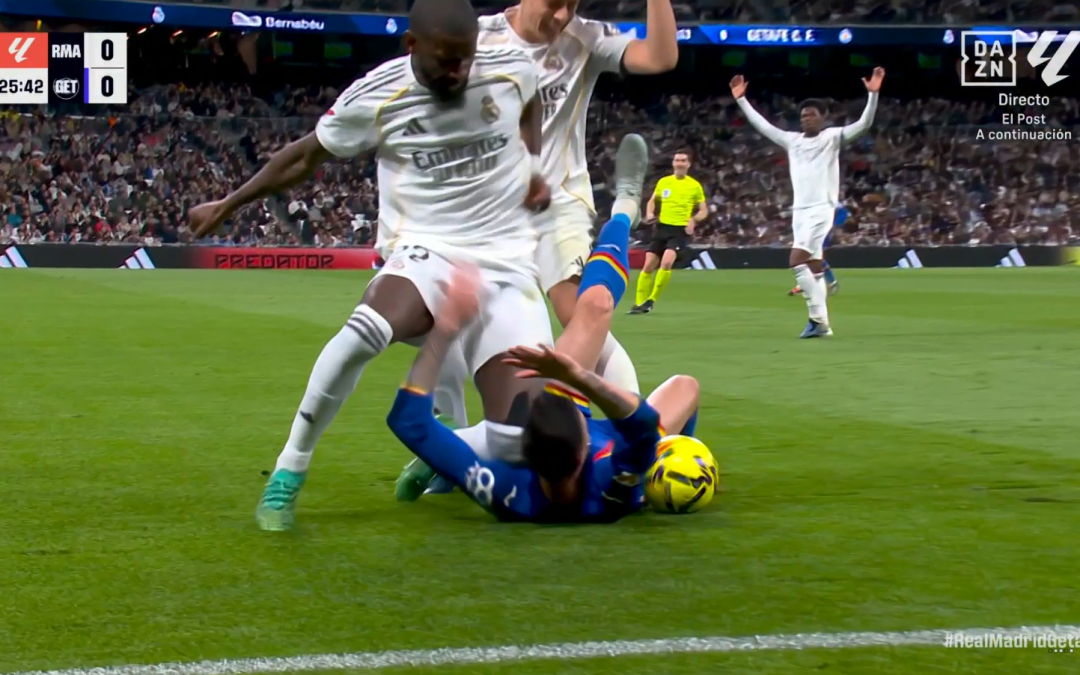
El colectivo arbitral se muestra unánime con la acción entre Rudiger y Diego Rico que marcó por completo el Real Madrid – Getafe.
La acción de Antonio Rüdiger sobre Diego Rico en el Real Madrid – Getafe ha dejado de ser simplemente una jugada polémica para convertirse en un caso de estudio dentro del arbitraje español. No solo por la gravedad del gesto, sino por lo que ocurrió después: la absoluta pasividad del VAR. Y, según ha podido saber Archivo VAR, existe unanimidad en el colectivo arbitral sobre un punto clave: la acción debió ser roja directa y encaja disciplinariamente en un rango de sanción de entre 4 y 12 partidos por conducta violenta con premeditación y alevosía.
No estamos hablando de una jugada gris. No estamos ante una interpretación fina o dividida. La secuencia es clara. Ambos jugadores venían ya de un encontronazo previo minutos antes. En la acción determinante, Diego Rico cae al suelo y Rüdiger se encuentra a varios metros. No es una caída simultánea ni un choque inevitable. El central alemán observa al rival en el suelo, modifica su trayectoria y termina impactando con la rodilla en la zona de la mandíbula. No hay balón en disputa, no hay intento de jugar la pelota, no hay gesto técnico justificable.
🖥️💥 El VAR pasó por completo de una clara agresión de Rüdiger a Rico.
👉🏻 El alemán, que solo fija la mirada en su rival, le da un rodillazo de forma intencionada en el rostro.
❌ 𝗥𝗢𝗝𝗔 𝗗𝗜𝗥𝗘𝗖𝗧𝗔 𝗖𝗟𝗔𝗥𝗔.
▪️ Incomprensible la pasividad de Pizarro Gómez desde el VAR. pic.twitter.com/4Io4PL5nk2
— Archivo VAR (@ArchivoVAR) March 2, 2026
Una agresión con premeditación y alevosía
Dentro del análisis arbitral, esos elementos, distancia previa, ausencia de balón y modificación de trayectoria, son los que permiten encuadrar la acción como conducta violenta con premeditación y alevosía. Y ese encuadre, según el Código Disciplinario, sitúa este tipo de comportamientos en el tramo de sanción que puede oscilar entre 4 y 12 encuentros.
Lo que agrava el escenario es que Muñiz Ruiz, en directo, no señala ni siquiera falta. Puede entenderse que, por velocidad o posición, el árbitro principal no percibiera la magnitud del gesto. Pero ahí entra el VAR. Y aquí aparece el nombre propio que centra ahora el debate: Pizarro Gómez.
La función del VAR es intervenir precisamente en este tipo de situaciones: agresiones fuera de balón, conductas violentas que puedan escapar al ojo humano en tiempo real. No se trata de interpretar un contacto leve, ni de valorar una intensidad dudosa. Se trata de una acción que, revisada en cámara lenta, muestra un impacto claro y una acción voluntaria sin disputa.
A Pizarro Gómez le espera, o debería esperar, la nevera
Que Pizarro Gómez no recomendara revisión en monitor es, para el entorno arbitral, uno de los errores más graves de la temporada. Y probablemente el más evidente en materia disciplinaria. No es una cuestión opinable: es una acción que el propio colectivo encuadra como roja clara.
Por eso la segunda derivada es inevitable. Ha habido árbitros que, por errores mucho menos determinantes, han permanecido tres o cuatro jornadas sin designación. Incluso un mes completo. Si tras una acción que el propio colectivo considera encuadrable en conducta violenta grave no existe consecuencia interna, el mensaje que enviará el CTA será devastador para su ya erosionada credibilidad.
No se trata de señalar a una persona por sistema. Se trata de coherencia. Si la política interna contempla descanso forzoso para errores graves, este caso encaja de lleno en ese supuesto. Cualquier escenario en el que Pizarro Gómez no pase un periodo en la nevera sería interpretado como un agravio comparativo respecto a otros colegiados sancionados por situaciones menos trascendentes.
El CTA se vuelve a jugar la poca credibilidad que le queda
La unanimidad arbitral no es habitual. En muchas jugadas siempre hay matices, visiones distintas o interpretaciones alternativas. Aquí no. El consenso es prácticamente total: roja directa y encuadre disciplinario severo debido a la premeditación y alevosía que muestra el defensor del Real Madrid durante todo el desarrollo de la acción.
La cuestión ya no es si la acción era roja, para el colectivo arbitral lo era. La cuestión es qué credibilidad conserva el sistema si una conducta que encaja en el rango más alto de sanción posible ni siquiera activa la intervención del VAR en directo.
🇬🇧 Read full English version
The refereeing community is unanimous regarding the Rüdiger–Diego Rico incident that completely defined Real Madrid – Getafe
Antonio Rüdiger’s action on Diego Rico during Real Madrid – Getafe has ceased to be merely a controversial moment and has become a case study within Spanish refereeing. Not only because of the seriousness of the act itself, but because of what followed: the absolute passivity of the VAR. And, as Archivo VAR has learned, there is unanimity within the refereeing community on one key point: the action should have resulted in a straight red card and falls within a disciplinary range of between 4 and 12 matches for violent conduct carried out with premeditation and intent.
This is not a grey-area incident. It is not a finely balanced or divided interpretation. The sequence is clear. Both players had already clashed minutes earlier. In the decisive moment, Diego Rico falls to the ground while Rüdiger is several meters away. It is not a simultaneous fall or an unavoidable collision. The German defender sees his opponent on the ground, alters his path, and ultimately strikes him with his knee to the jaw area. There is no ball being contested, no attempt to play it, no technical gesture that could justify the movement.
An act of aggression with premeditation and intent
From a refereeing analysis perspective, those elements — prior distance, absence of the ball, and change of trajectory — are precisely what allow the action to be classified as violent conduct with premeditation and intent. Under the Disciplinary Code, such behavior falls within a sanction range that can extend from 4 to 12 matches.
What aggravates the situation further is that Muñiz Ruiz, in real time, did not even award a foul. It can be understood that due to speed or positioning, the on-field referee may not have perceived the magnitude of the act. But that is precisely where VAR is meant to intervene. And here, one name now stands at the center of the debate: Pizarro Gómez.
The role of VAR is to step in during exactly these kinds of situations: off-the-ball aggression, violent conduct that may escape the human eye at full speed. This is not about interpreting slight contact or assessing doubtful intensity. It is about an action that, when reviewed in slow motion, clearly shows deliberate impact without any dispute for the ball.
Pizarro Gómez faces — or should face — suspension
The fact that Pizarro Gómez did not recommend an on-field review is considered within refereeing circles to be one of the most serious errors of the season. And probably the clearest in disciplinary terms. It is not a debatable issue: it is an action that the refereeing collective itself classifies as a clear red card.
This leads inevitably to the next question. There have been referees who, for far less decisive errors, have remained without appointments for three or four matchdays — even a full month. If, after an incident that the refereeing community itself categorizes as severe violent conduct, there is no internal consequence, the message sent by the Technical Committee of Referees (CTA) would be devastating for its already weakened credibility.
This is not about targeting an individual. It is about consistency. If internal policy includes enforced rest periods for serious mistakes, this case fully meets that threshold. Any scenario in which Pizarro Gómez does not spend time sidelined would be interpreted as unequal treatment compared to other officials previously sanctioned for less significant situations.
The CTA once again risks the little credibility it has left
Unanimity among referees is not common. In many situations there are nuances, differing views, or alternative interpretations. Not here. The consensus is virtually total: straight red card and severe disciplinary classification due to the clear premeditation and intent shown by the Real Madrid defender throughout the action.
The question is no longer whether the incident warranted a red card — for the refereeing community, it clearly did. The real question is what credibility remains within the system if conduct that falls within the highest possible sanction range does not even trigger a VAR intervention in real time.