
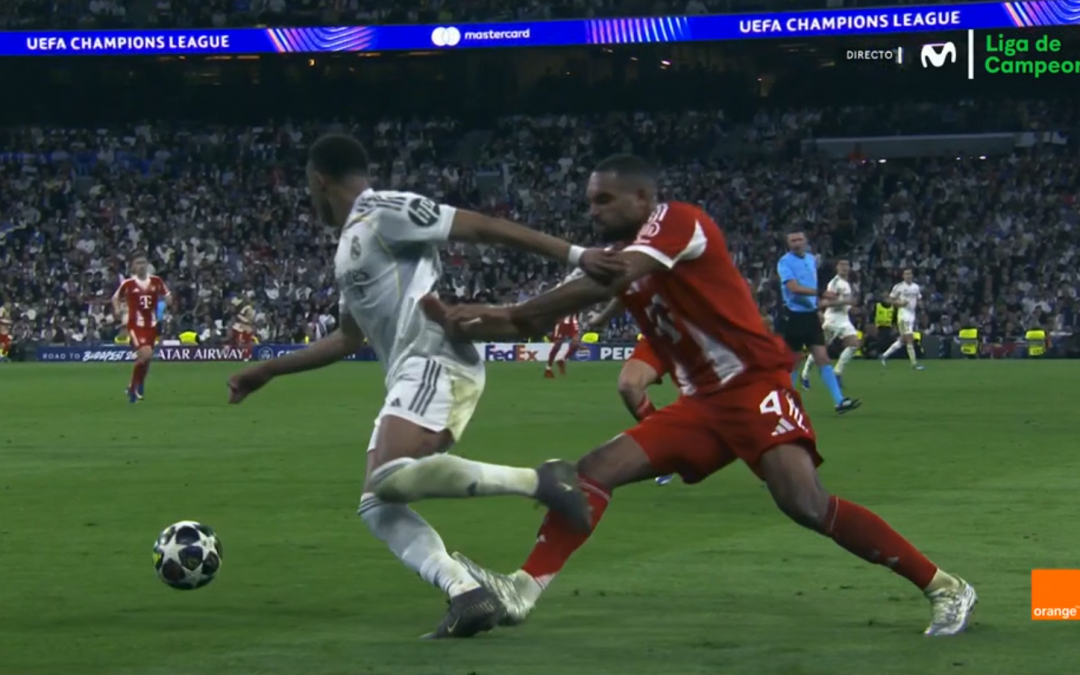
El Real Madrid – Bayern Munich, dirigido por Michael Oliver, contó con cuatro acciones polémicas y dos dudas con respecto a las tarjetas amarillas.
El partido entre el Real Madrid y el Bayern de Múnich dejó varias acciones polémicas que han generado debate en las últimas horas, especialmente en jugadas dentro del área. En total, cuatro acciones clave marcaron el análisis arbitral del encuentro, a las que se suman dos decisiones disciplinarias discutibles. En líneas generales, la actuación de Michael Oliver fue solvente en las jugadas determinantes, aunque con cierta irregularidad en el criterio a la hora de mostrar tarjetas.
¿Mano previa al gol de Olise?
La primera acción polémica llega en el origen del primer gol del Bayern de Múnich. En la recuperación, el balón impacta en el brazo de Olise tras un intento de pase de Vinicius. Sin embargo, se trata de una mano totalmente natural, con el brazo pegado al cuerpo, sin ocupación de espacio adicional. Además, Olise no es el jugador que finaliza la jugada, ya que el gol lo marca posteriormente Luis Díaz. Este matiz es clave, ya que solo se sancionan este tipo de acciones si el propio jugador que comete la mano marca inmediatamente. Por tanto, ni la acción es punible ni es revisable por el VAR. El gol del Bayern es completamente legal.
⁉️💥 ¿Hay mano de Olise previa al gol de Luis Díaz?
✅ 𝗡𝗢.
👉🏻 El balón golpea en el codo del francés estando pegado al cuerpo y en posición natural.
▪️ Además, el VAR solo podría revisar este tipo de acciones en caso de ser una mano totalmente punible o voluntaria. pic.twitter.com/42YJ7fcmID
— Archivo VAR (@ArchivoVAR) April 7, 2026
¿Penalti sobre Vinicius?
Poco después, se produce una acción muy protestada por Vinicius dentro del área. El brasileño se interna por banda izquierda y recibe un leve contacto de Upamecano. Existe un toque mínimo, pero en ningún caso suficiente para provocar la caída. De hecho, Vinicius, al sentir ese contacto, se deja caer de forma clara. No hay zancadilla, no hay derribo ni una acción que impida continuar la jugada. El árbitro, además, termina señalando mano de Vinicius al caer. Se trata de una acción en la que el contacto existe, pero es completamente insuficiente para señalar penalti. Decisión correcta de Michael Oliver.
⁉️💥 ¿Hay penalti de Upamecano sobre Vinicius?
✅ 𝗡𝗢.
👉🏻 El central francés toca muy ligeramente al brasileño que, tras sentir el contacto, se deja caer.
▪️ Michael Oliver, muy cerca de la acción, perdonó la tarjeta amarilla a Vinicius. pic.twitter.com/iqZQmQX2fl
— Archivo VAR (@ArchivoVAR) April 7, 2026
Entrada por detrás de Tah sobre Mbappé
La tercera jugada, ya en la segunda parte, es probablemente la más controvertida del partido. Se trata de una entrada de Tah sobre Mbappé por detrás. El defensor del Bayern contacta con la zona de la puntera de la bota sobre el gemelo del delantero francés, provocándole un rasponazo que incluso rompe la media. La imagen es aparatosa, pero el análisis debe centrarse en el tipo de contacto. No hay un impacto pleno con la plancha ni una presión directa con fuerza excesiva, sino un rasponazo.
Es una acción muy al límite que entra dentro del terreno de la interpretación. Si el árbitro hubiera mostrado roja en directo, el VAR no habría intervenido, pero al mostrar amarilla tampoco puede hacerlo, ya que no existe un error claro y manifiesto. Es una jugada gris, bien resuelta desde el punto de vista reglamentario.
⁉️💥 ¿Es revisable por el VAR la acción de Tah sobre Mbappé?
✅ 𝗡𝗢.
👉🏻 El defensor alemán raspa con la plancha el gemelo del delantero del Real Madrid.
▪️ Si bien el defensor se la juega, al no existir un contacto directo con la totalidad de la plancha, se queda en amarilla. pic.twitter.com/wvgBosk8f4
— Archivo VAR (@ArchivoVAR) April 7, 2026
¿Penalti sobre Olise en el último minuto?
La última gran acción del partido llega en los minutos finales con un posible penalti de Carreras sobre Olise. El balón llega por alto y el atacante del Bayern retrocede para intentar controlarlo, mientras el defensor del Real Madrid avanza hacia la misma zona. Ambos jugadores convergen en el mismo punto y se produce un contacto.
La clave de la acción está precisamente en eso: no es Carreras quien va de forma agresiva hacia Olise, sino que ambos coinciden en la misma posición. Olise retrocede y Carreras avanza, produciéndose un choque de trayectorias. El contacto existe, pero no es de intensidad suficiente como para considerarlo un error claro del árbitro. De nuevo, es una acción gris en la que si se señala penalti no sería una locura, pero al no señalarlo, el VAR no puede intervenir. Decisión defendible.
⁉️💥 ¿Debió intervenir el VAR en la acción entre Olise y Carreras?
✅ 𝗡𝗢.
👉🏻 Olise retrocede buscando el balón y Carreras choca con él, sin que el contacto sea de gran intensidad.
▪️ Acción muy gris que en ningún caso se trata de un error claro y manifiesto. pic.twitter.com/RtSbvAuJoP
— Archivo VAR (@ArchivoVAR) April 7, 2026
¿Amarilla justa a Tchouameni?
Más allá de estas acciones, el partido también dejó dudas en el apartado disciplinario. Una de ellas fue la tarjeta amarilla mostrada a Tchouaméni, en una acción en la que el jugador francés apenas realiza un contacto leve en carrera. Se trata de una decisión excesiva, especialmente si se compara con otras acciones similares durante el partido que no fueron sancionadas de la misma forma.
¿Amarilla a Vinicius por simulación?
En este sentido, también genera debate la posible amarilla a Vinicius por simulación en la acción ante Upamecano. El brasileño se deja caer claramente tras un contacto mínimo, lo que podría haber sido sancionado con tarjeta amarilla. Un árbitro más estricto en este tipo de acciones podría haberle amonestado sin problemas, lo que además habría tenido consecuencias importantes al tratarse de una posible suspensión para el partido de vuelta. Sin embargo, Michael Oliver optó por una gestión más dialogante y permisiva en este aspecto.
Este punto refleja una cierta incoherencia en el criterio disciplinario durante el partido. Si se sanciona con amarilla una acción como la de Tchouaméni, otras acciones similares deberían recibir el mismo tratamiento. La falta de uniformidad en este tipo de decisiones es lo que deja una sensación más irregular en la actuación arbitral.
Solvente arbitraje de Michael Oliver… con algún error
En definitiva, el arbitraje de Michael Oliver en el Real Madrid – Bayern de Múnich fue sólido en las acciones clave del partido. Supo interpretar correctamente las jugadas más importantes y el VAR actuó de forma coherente al no intervenir en acciones que no alcanzaban el umbral de error claro y manifiesto. Sin embargo, el criterio disciplinario dejó algunas dudas, con decisiones poco consistentes en la gestión de las tarjetas.
El balance final es claro: acierto en lo importante, en las jugadas que deciden partidos, y margen de mejora en el control del juego y la coherencia disciplinaria. Un arbitraje que resolvió bien las acciones más complejas, pero que no terminó de ser uniforme en los detalles.
🇬🇧 Read full English version
Real Madrid vs Bayern Munich, officiated by Michael Oliver, featured four controversial incidents and two questionable yellow card decisions
The match between Real Madrid and Bayern Munich produced several controversial moments that have sparked debate in recent hours, particularly in incidents inside the penalty area. In total, four key situations defined the refereeing analysis of the game, along with two debatable disciplinary decisions. Overall, Michael Oliver delivered a solid performance in the decisive moments, although with some inconsistency in his disciplinary approach.
Handball before Olise’s goal?
The first controversial incident came in the build-up to Bayern Munich’s opening goal. During the recovery phase, the ball struck Olise’s arm following a pass attempt by Vinicius. However, this was a completely natural handball, with the arm close to the body and no unnatural enlargement of the silhouette. Moreover, Olise was not the player who finished the move, as the goal was later scored by Luis Díaz. This detail is crucial, as such handball situations are only punishable if the same player immediately scores. Therefore, the action is neither punishable nor reviewable by VAR. Bayern’s goal is fully valid.
Penalty on Vinicius?
Shortly after, a highly protested incident occurred involving Vinicius inside the penalty area. The Brazilian drove into the box from the left and received slight contact from Upamecano. There is minimal contact, but nowhere near enough to justify the fall. In fact, Vinicius clearly goes down after feeling the touch. There is no trip, no clear foul and nothing that prevents him from continuing the play. The referee ultimately awarded a handball against Vinicius as he fell. This is a situation where contact exists, but is clearly insufficient for a penalty. Correct decision by Michael Oliver.
Tah’s challenge from behind on Mbappé
The third incident, in the second half, is probably the most controversial of the match. It involved a challenge from behind by Tah on Mbappé. The Bayern defender made contact with the toe of his boot on the French forward’s calf, causing a scrape that even tore his sock. The image looks dramatic, but the key lies in the type of contact. There is no full studs impact nor excessive force, only a grazing contact.
This is a very borderline situation that falls within the referee’s interpretation. If the referee had shown a red card on the field, VAR would not have intervened, but since a yellow card was given, VAR cannot step in either, as there is no clear and obvious error. A grey-area incident, well managed from a Laws of the Game perspective.
Penalty on Olise in the final minutes?
The final major incident came in the closing stages with a possible penalty involving Carreras and Olise. The ball arrives aerially and the Bayern attacker moves backwards to control it, while the Real Madrid defender moves forward into the same space. Both players converge and make contact.
The key to this action is precisely that: Carreras does not aggressively move into Olise, but both players arrive at the same spot. Olise moves backwards and Carreras forwards, resulting in a coming together. There is contact, but not enough intensity to be considered a clear refereeing error. Again, this is a grey-area situation where awarding a penalty would be understandable, but not awarding it means VAR cannot intervene. A defensible decision.
Correct yellow card for Tchouameni?
Beyond these incidents, the match also raised questions regarding disciplinary decisions. One of them was the yellow card shown to Tchouameni, in a situation where the French player made only minimal contact while running. It appears to be an excessive decision, especially when compared to similar actions during the match that were not punished in the same way.
Yellow card for Vinicius for simulation?
In this context, there is also debate about whether Vinicius should have been booked for simulation in his action against Upamecano. The Brazilian clearly goes to ground after minimal contact, which could have been punished with a yellow card. A stricter referee might have cautioned him, which could have had significant consequences as it may have led to a suspension for the second leg. However, Michael Oliver opted for a more lenient and dialogue-based approach in this regard.
This reflects a certain inconsistency in the disciplinary criteria during the match. If an action like Tchouameni’s is punished with a yellow card, similar incidents should receive the same treatment. This lack of uniformity is what leaves a more irregular impression of the overall refereeing performance.
A solid performance by Michael Oliver… with some flaws
In conclusion, Michael Oliver’s refereeing performance in the Real Madrid vs Bayern Munich match was solid in the key moments of the game. He correctly interpreted the most important incidents and VAR acted consistently by not intervening in situations that did not reach the threshold of a clear and obvious error. However, his disciplinary approach left some doubts, with inconsistent decisions in the management of yellow cards.
The overall assessment is clear: correct decisions in the crucial moments that decide matches, but room for improvement in game control and disciplinary consistency. A performance that handled the most complex incidents well, but lacked uniformity in the details.